



Product Description
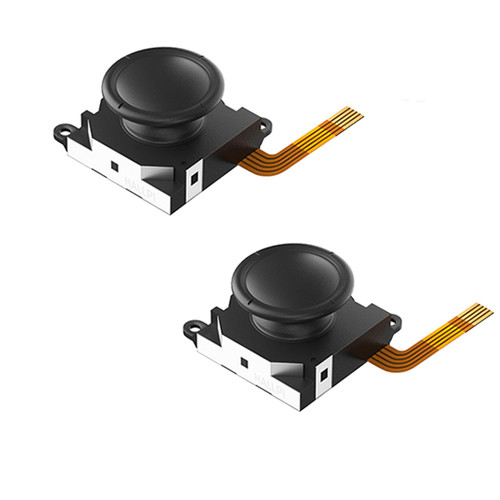
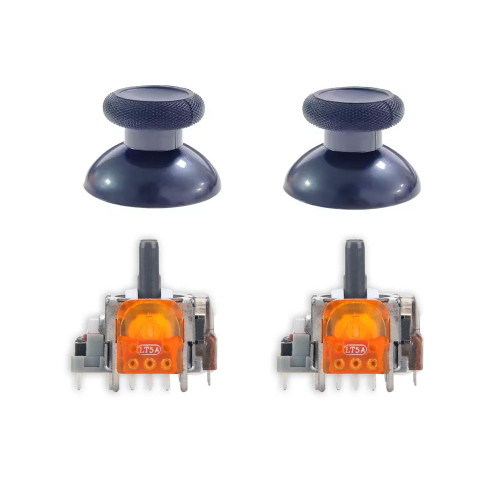
Never worry about stick drift again with AKNES HallPi TMR replacement thumbstick modules. Set includes 2 thumbstick modules and premium replacement thumbstick caps in multiple colors.
- Drift Solution & Precision Control - Upgrade your Switch / Switch OLED / Switch Lite JoyCon with TMR (Tunnel Magnetoresistance) Joystick - the evolution beyond Hall Effect joysticks. Featuring contactless magnetic sensing, it resolution regular carbon film stick drift, jitter, and dead zones issue.
- Simplified Installation & Trusted Guidance - The drop-in design modular replacement kit matches original Joy-Con dimensions perfectly—no soldering or technical skills needed. Swap joysticks in minutes using repair toolkit (tools included) and step-by-step iFixit video guide.
- Complete Repair Kit - Everything included for seamless installation: 2 AKNES TMR joystick modules, 2 Thumb Stick Cap, specialized repair tools (18 x Screws, 1 x Phillips screwdriver, 1x Y-type screwdriver, 1 x Tweezers, 1 x Triangle paddle (pry tool).
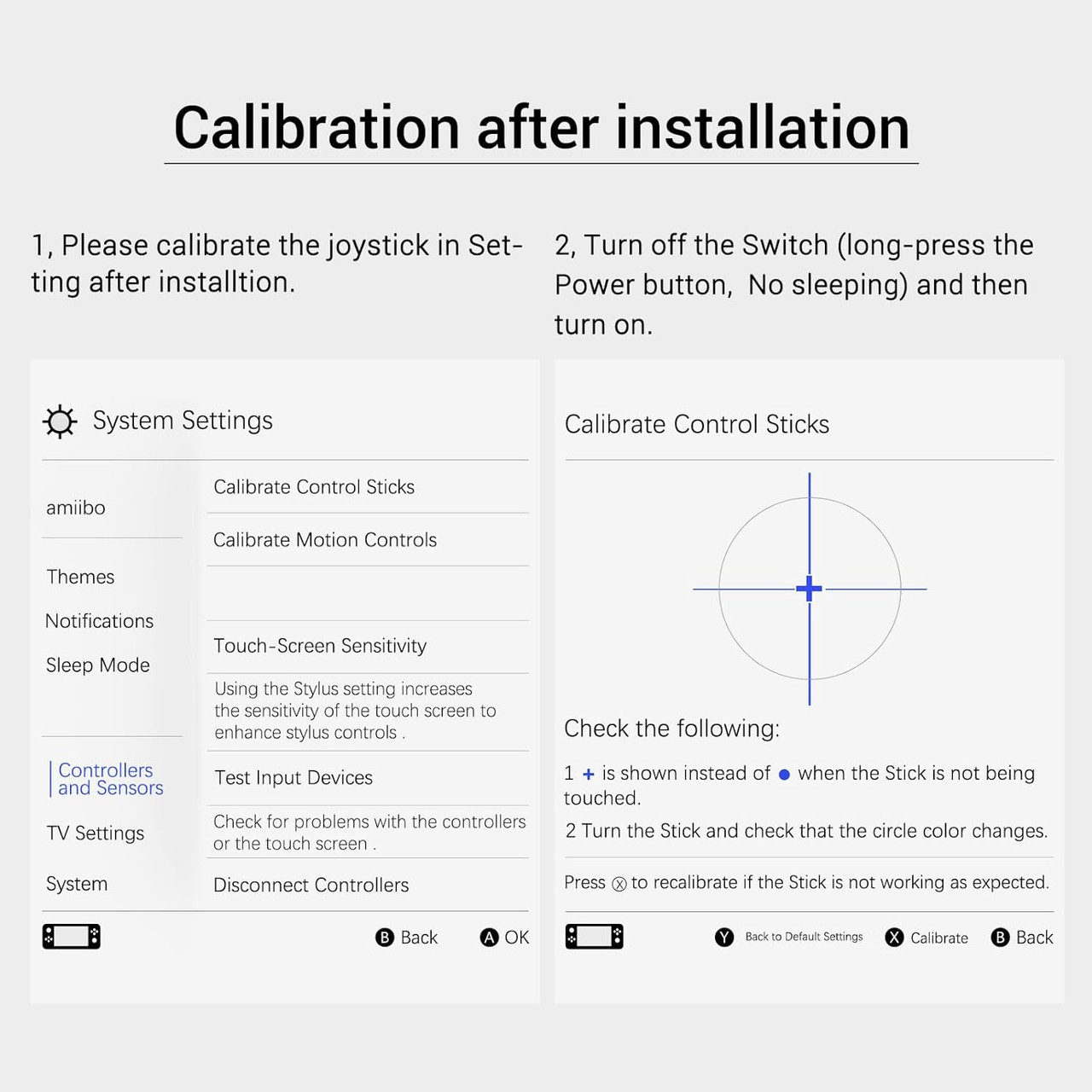
- Calibration - After installation, please run joystick calibration (Switch System Setting→Controller and Sensor→Calibrate Control Sticks→Follow the prompts to finish joystick calibration).
Additionally, some questions below are addressed:
1. Why do the replacement joysticks for Sony, Microsoft, and Nintendo's original controllers need to use TMR electromagnetic joysticks rather than Hall electromagnetic joysticks?
The original design of Sony, Microsoft, and Nintendo game controllers uses traditional resistive film joystick technology with a constant power supply design, with a power capacity limited to about 1mA. The power consumption of single TMR sensor is between 0.1mA and 0.3mA, while single linear Hall sensor consume 0.5mA to 2mA. This makes linear Hall sensors can not work very well, while the TMR electromagnetic joystick have lower power consumption and perform much better, and TMR electromagnetic joystick can be installed as a perfect 1:1 replacement without any other circuit modifications.
2. Is the resolution of the TMR joystick much higher than Hall effect joysticks?
No, that's not the case. Carbon film joysticks, TMR joysticks, and Hall effect joysticks are all linear devices. TMR joysticks and Hall effect joysticks are both a type of electromagnetic joystick. For game controllers, the bandwidth of these three types of joystick sensors is sufficient. The resolution mainly depends on the sampling precision of the backend MCU, and is not closely related to the joystick itself. So after replacement, the joystick resolution, polling rate, and other performance characteristics will be consistent with the original controllers.
3. Is the power consumption of the TMR electromagnetic joystick much lower than the Hall electromagnetic joystick?
If only considering the sensors, the TMR sensor does have lower power consumption. However, if the original game controller design already uses Hall electromagnetic joysticks, such as GuliKit's KK2 and KK3 controllers, good technical methods can be used in the controller design process to control the power consumption of the Hall electromagnetic joystick to 0.1-0.3mA,which makes no big difference on the controller battery life.
4. After replacing the TMR joystick on the Switch Pro controller, if there are significant joystick errors or it cannot move in a full circle during testing on PC, could there be an issue with the joystick?
The calibration method for the Switch Pro controller is somewhat different from that of Microsoft and Sony controllers. Both Microsoft and Sony controllers directly modify the original joystick parameter values for calibration, whereas the Switch Pro controller uses a combination of original values and calibration values. When the Switch Pro controller is called, it needs to use both the original values and calibration values to form the actual joystick parameters. Therefore, its calibration and testing need to be conducted on the Switch console,not on PC.
Currently, most PC testing softwares directly call the original values without using the calibration values in calculations, which can lead to issues such as joystick offset and inability to move in a full circle during PC testing. Since the factory calibration parameters for original controllers are relatively small, this phenomenon may not be as evident. After replacing the joystick, the calibration values may increase, making the offset or not full circle moving issues more pronounced.
*Since the joystick models vary across different controllers and have size differences, do not remove and replace just the side components of the joystick. Instead, the entire joystick needs to be replaced as a whole. Attempting to replace only the individual components on the joystick may result in issues like joystick damage or poor centering performance.